
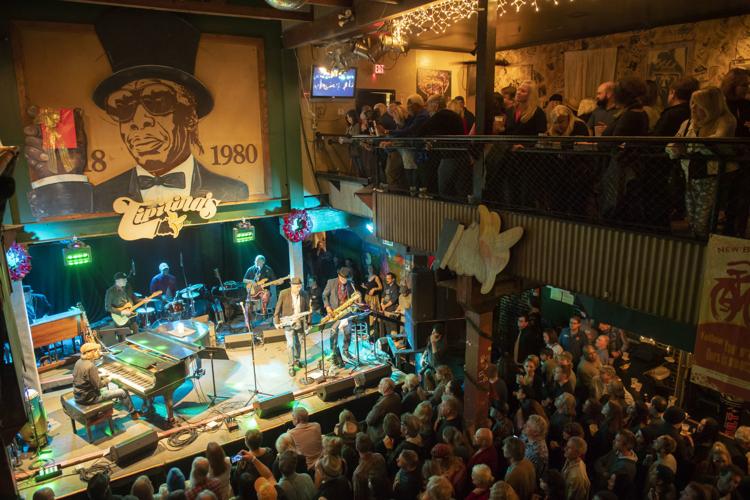

At one of New Orleans’ most beloved rooms, LongFi Connect helps the crowd stay connected without changing what makes the place matter
A Ritual at the Door
Every person who walks into Tipitina’s for the first time does the same thing: they touch the bust.
It’s Professor Longhair at the door on Napoleon Avenue, worn smooth by decades of hands. A quick ritual before the music starts. Nobody has to explain it. In a city that treats music like inheritance, some places earn reverence without ever asking for it. Tipitina’s is one of them.
Inside, the room opens fast: low stage, bar to the side, Professor Longhair — known to generations of fans as Fess — watching from above. The building has been standing since 1912. Long before it became one of the most important music rooms in New Orleans, it lived other lives as a gambling house, a gymnasium, a brothel, and a longshoremen’s bar. Then in 1977, a group of local music fans pooled roughly $14,000 to take over the old 501 Club and give Professor Longhair a proper home. They named it after his 1953 song, “Tipitina,” and in doing so gave New Orleans a room that could hold memory.
From the beginning, the place came out of a simple impulse: make room for the music, and make sure people could find their way to it.
A Venue That Stands the Test of Time
Tipitina’s has nearly disappeared more than once. It took hard hits after the 1984 World’s Fair. It got squeezed in the 1990s when bigger, better-capitalized operators moved into town. It nearly unraveled again in the late 2010s. Then came the pandemic, when live music everywhere went quiet and independent venues were forced into survival mode. Each time, Tipitina’s came back for the same reason: somebody who loved the place decided it was too important to lose.
That same instinct carried into the current era when Galactic took over in 2018. Their stewardship has followed a simple principle: renovate without erasing. Improve the sound. Improve the sightlines. Improve the backstage and the things the audience depends on. Leave the soul of the room alone. Tipitina’s does not need reinvention in the grand, corporate sense. It needs care. It needs people who understand the difference between preserving history and freezing it in place.
Which is what makes the next part of the story feel less like a tech add-on and more like the next practical step.
The Modern Crowd Problem
A room like Tipitina’s now carries more than music. It carries the digital habits of a modern crowd. During a sold-out show, hundreds of people are pulling out their phones at once. They are texting friends to come inside. Posting clips between songs. Pulling up mobile tickets. Tapping to pay at the bar. Checking on a babysitter. Ordering a ride before the sidewalk fills up. In a dense crowd inside a historic building, cellular service can start to strain fast.
It is not unique to Tipitina’s. Put enough people in one room, wrap them in old walls and modern expectations, and the network is often the first thing to feel it. The music is still there. The room still has its magic. But the practical layer of the night starts to fray. The message hangs. The video stalls. The payment spins. Small friction, until it isn’t.
LongFi Connect on Tipitina’s Existing Ubiquiti Network
At Tipitina’s, LongFi Connect was deployed on the venue’s existing Ubiquiti network using Passpoint. For cell phone subscribers, that means seamless connection to the venue’s enterprise Wi-Fi without an app download, password entry, or awkward login screen. Their phones simply connect in the background.
That’s the value of it. In a room like Tipitina’s, the infrastructure should not ask anyone to stop and figure something out. It should not make the night feel more technical than musical. It should quietly do its job so the experience keeps moving.
And when connectivity works, nobody stops to admire it. They send the clip. Complete the transaction. Find their friends. Call the ride. The technology stays in the background, where it belongs.
An Upgrade That Respects the Room
This is also not the kind of upgrade that asks an independent venue to behave like a telecom company. LongFi’s model means the venue is not taking on a big new cost just to solve a problem created by modern mobile demand. For a place that has spent decades protecting itself from being squeezed out, that is not a small thing.
LongFi has already shown this approach can hold up at real New Orleans scale. During Mardi Gras 2026 in the French Quarter, LongFi deployments handled more than 144,000 unique carrier subscribers on Fat Tuesday. Tipitina’s is a different setting, obviously, but the underlying challenge is familiar: dense crowds, high mobile demand, and a need for connectivity that works without getting in the way.
The deployment fits because it follows the same logic that has kept the venue alive for nearly fifty years. Protect what matters. Upgrade what people depend on. Don’t mess with the room.
The Mission Hasn’t Changed
Tipitina’s was founded, in a sense, to remove a barrier between a great musician and the people who wanted to hear him. Its history since then has been one long variation on that theme. Save the room. Protect the culture inside it. Keep the distance between stage and crowd as open as possible. In 2026, one of those barriers happens to be connectivity. Not the romantic kind. The practical kind. The kind nobody talks about until it fails.
A century after the building went up, and nearly fifty years after a handful of fans scraped together $14,000 to give Professor Longhair a place to play, Tipitina’s is still doing what it has always done: adapting without surrendering what made it matter in the first place.
Touch the bust on your way in.
The rest should feel invisible.